
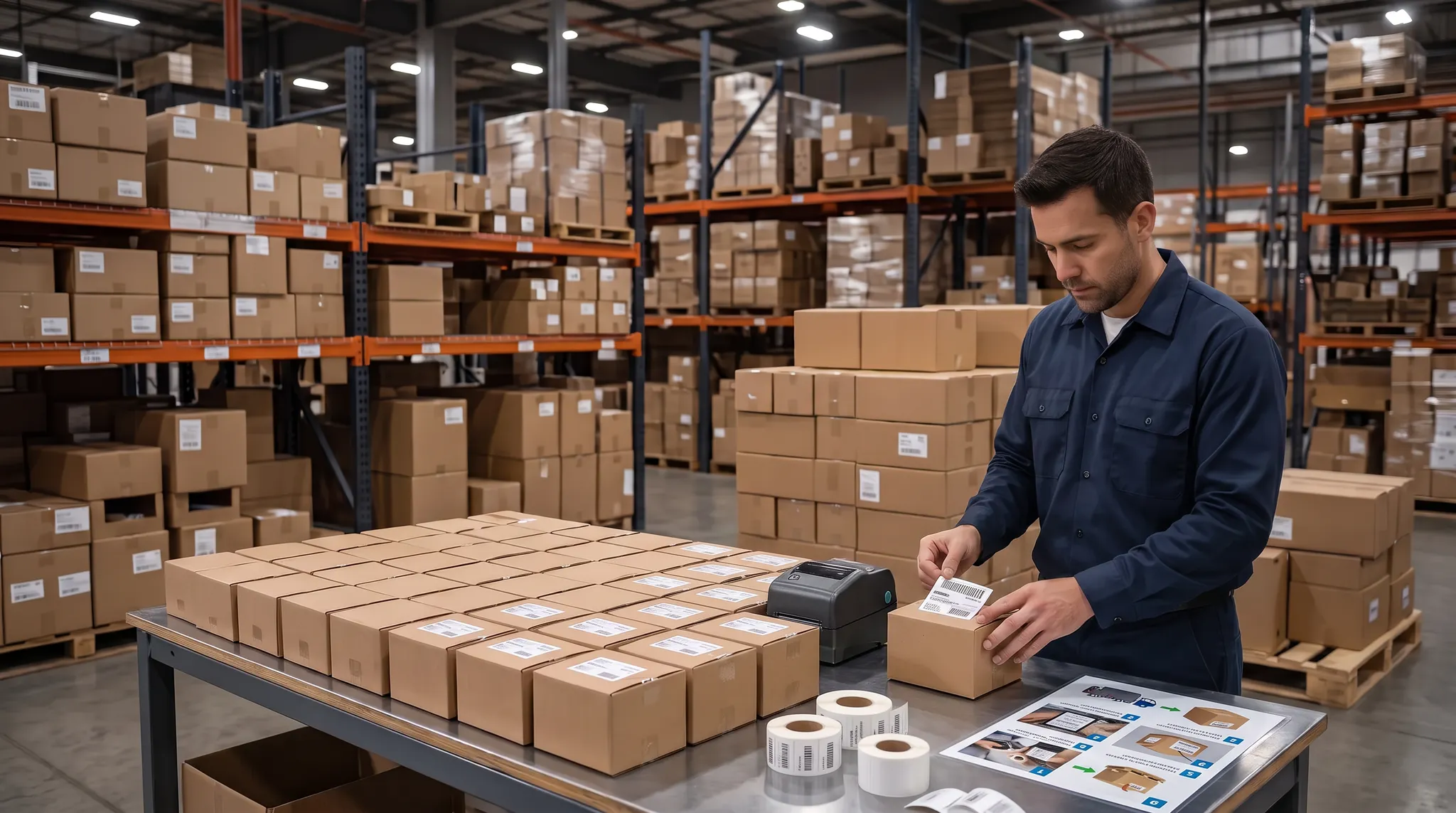
The short answer
Amazon FBA prep requirements come down to five checks: use the correct barcode, keep every label readable, secure each sellable unit, apply product-specific protection, and remove misleading barcodes from shipping boxes. Amazon can refuse, return, or repackage inventory that arrives with inadequate or noncompliant packaging, so confirm the current instructions in Seller Central before every shipment.
This checklist summarizes Amazon’s current public guidance. Your product’s shipment workflow remains the final source of truth.
FBA prep checklist at a glance
Before inventory leaves your facility, verify that:
- Every sellable unit has the correct scannable barcode.
- The active barcode is flat, readable, and not covered by other packaging.
- Old or conflicting barcodes are covered or made unscannable.
- Loose products and sets are secured as one sellable unit.
- Fragile, sharp, liquid, textile, small, and other special products have the required protection.
- Each shipping box matches the shipment plan and has no unrelated scannable barcodes.
- Counts, labels, packaging, and box contents pass a final quality-control check.
Confirm the barcode type
Amazon uses barcodes to identify products and track inventory through fulfillment. According to Amazon’s July 2026 FBA prep guide, the applicable identifier can be a manufacturer barcode, an Amazon barcode, or a Transparency code.
Manufacturer barcodes include UPC, EAN, JAN, and ISBN identifiers. Amazon barcodes are required for inventory that is not tracked with a manufacturer barcode and for certain products or conditions. Transparency codes are item-level authentication codes for enrolled products and should not be covered by another label.
Do not assume one barcode setting applies to every SKU. Check the product and shipment in Seller Central before printing labels, especially when inventory condition, product restrictions, dangerous-goods status, or Brand Registry eligibility may change the requirement.
Print and place labels so they scan
A correct barcode can still fail if the label is damaged, curved, hidden, or assigned to the wrong product.
Amazon advises sellers to place labels on a smooth, flat surface rather than a corner, edge, or curve. When an Amazon barcode is the active identifier, cover other scannable product barcodes so receiving does not scan the wrong code. If a product needs extra protection such as bubble wrap, put the label on the outside of that prep so it remains accessible.
Add a verification step after labeling. Match the product title, condition, and FNSKU to the physical unit, then scan a sample from each SKU before packing the shipment.
Secure each sellable unit
Each unit should arrive as one complete, secure package. Loose parts, open packaging, or items that can separate during handling create receiving and customer-experience problems.
Amazon’s guidance says products sold as a set should be packaged together and marked with language such as “Sold as set” or “This is a set. Do not separate.” Loose products may need a sealed bag, removable tape, or another approved method that keeps the unit together without damaging it.
Case-packed inventory also needs consistent SKUs, conditions, and quantities. Keep individual units distinct from case-packed products in the shipment plan and physical packing process.

Apply product-specific prep
General packaging is not enough for every catalog. Amazon lists additional prep for categories that can leak, break, cut, collect dust, or become separated.
Examples in Amazon’s current guidance include:
- Apparel, textiles, powders, granular products, plush items, baby products, jewelry, small products, and some liquids that may need sealed bagging.
- Fragile products, ceramics, glass, and sharp items that may need secure bubble wrap or other protection.
- Footwear that must be fully enclosed so no material is exposed.
- Products sold as sets that need a visible “do not separate” instruction.
Requirements vary by product. Review Amazon’s product packaging requirements and the prep category shown in the shipment workflow instead of relying on a generic checklist alone.
Prepare the shipping boxes
Unit prep and shipping-box prep are separate checks. Before cartons leave your facility, remove, cover, or render unscannable any unrelated barcodes on the outside of the box. This reduces the chance that receiving scans an old carrier, product, or warehouse label.
Then compare each carton with the final shipment plan. For shipment creation, the difference between Amazon box ID and carrier labels, freight handoff, and tracking, use the Send to Amazon shipment checklist. Verify box contents, unit counts, destination labels, weight, dimensions, and any required handling marks. Reopen exceptions instead of forcing a carton to match the plan on paper.
Run a final quality-control pass
The last check should happen after all unit prep is complete and before the carrier collects the shipment.
Use a repeatable review:
- Scan the active barcode on a sample from every SKU.
- Confirm other barcodes are covered where required.
- Check that sets and loose products cannot separate.
- Inspect product-specific prep for gaps, tears, exposed edges, or leaks.
- Match carton contents and labels to the shipment plan.
- Photograph or record exceptions before the boxes are sealed again.
A written checklist makes errors easier to trace. It also gives your team or prep partner the same standard for every replenishment.
When an FBA prep center helps
An FBA prep center can receive supplier inventory, inspect units, apply labels and protective prep, build cartons, and coordinate the outbound shipment to Amazon. The value is consistency when your team lacks warehouse space, trained labor, or time for repeated marketplace prep.
Rocket Packaging provides Amazon FBA prep services in Houston, including labeling, poly bagging, bundling, box prep, quality control, and shipment coordination. Standard prep turnaround is 24–72 hours after inventory is received, subject to the confirmed scope and current requirements.
If you are comparing partners, use these 12 questions for choosing an FBA prep center. Sellers using more than one marketplace can also review the differences between Amazon FBA and Walmart WFS prep.
Frequently asked questions
Does every FBA unit need a barcode?
Yes. Amazon says every unit needs a scannable identifier. The correct type may be a manufacturer barcode, Amazon barcode, or Transparency code, depending on the product and account settings.
Should I cover the UPC when applying an FNSKU label?
When the Amazon barcode is the active identifier, cover conflicting scannable barcodes so receiving does not scan the wrong code. Confirm the barcode setting for the SKU in Seller Central before labeling.
Which FBA products need extra prep?
Amazon identifies product-specific prep for categories such as liquids, apparel, textiles, powders, small items, fragile products, glass, ceramics, sharp items, footwear, and sets. The shipment workflow and current Seller Central help pages should guide the final decision.
What happens if FBA prep is not compliant?
Amazon says it may refuse, return, or repackage inventory with inadequate or noncompliant packaging at the seller’s expense. Problems can also delay receiving and make inventory unavailable for sale.
Can Rocket Packaging handle FBA prep for me?
Yes. Rocket Packaging handles labeling, poly bagging, bundling, box prep, quality control, and shipment coordination based on your products and current shipment requirements. Get Your Free Quote →