
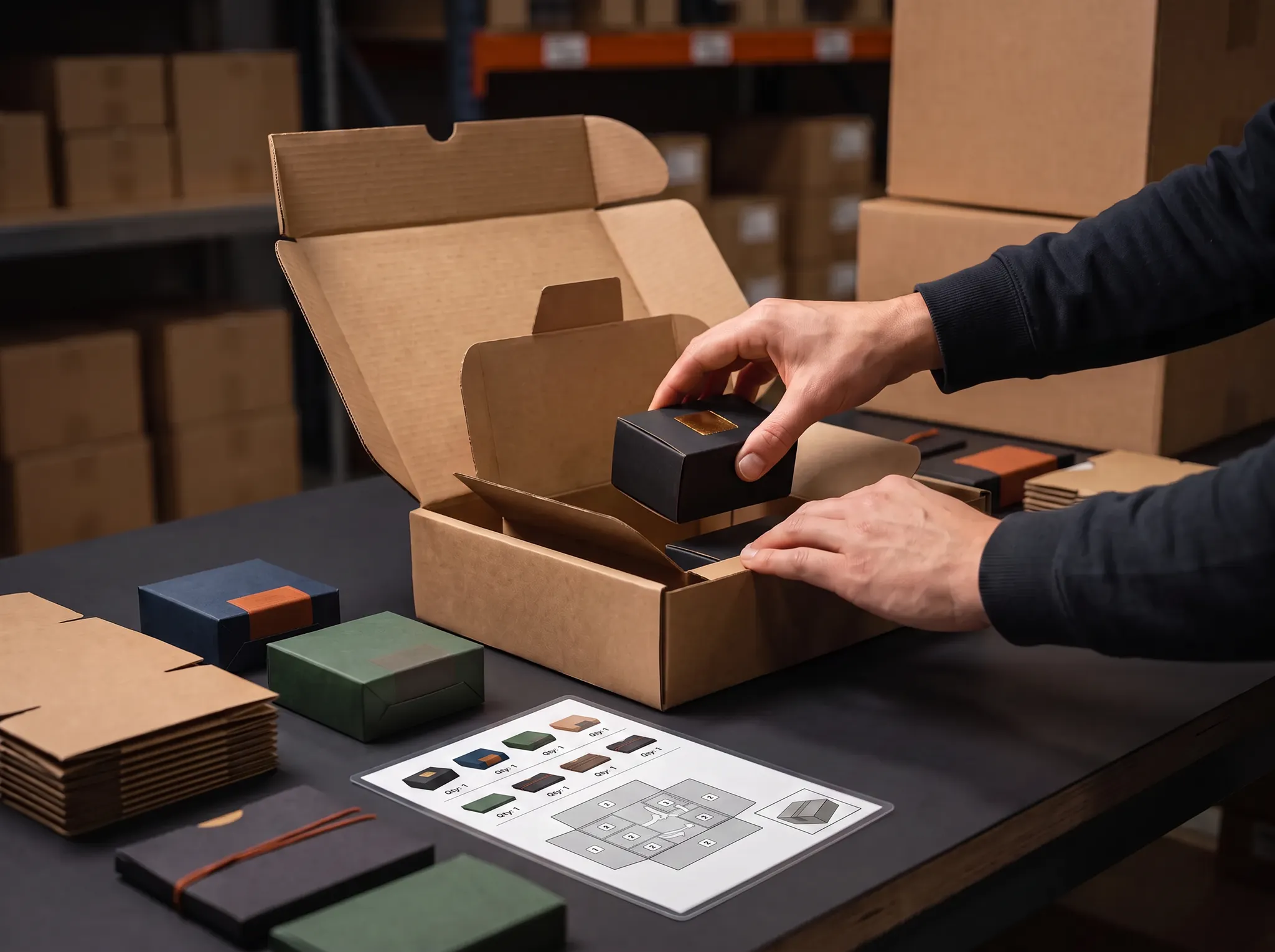
A kitting bill of materials lists every component that goes into one finished kit, with its identifier, quantity per kit, supplier, and packaging state. The checklist around it adds the rest of the build specification: the finished kit's own barcode, packaging and insert rules, an assembly sequence, an approved sample, quality checks at three points, and what happens when a component runs short. Send all of it to your 3PL before the first component ships, so the warehouse builds to a document instead of a conversation.
Use this checklist for subscription boxes, gift sets, multipacks, launch mailers, and any other kit you want built the same way every time. If you are still deciding whether to outsource kitting at all, start with our explainer on what kitting and assembly is.
Warehouse images illustrate kitting work. They do not show Rocket Packaging's facility or staff.
Kitting BOM checklist at a glance
- Give the finished kit its own SKU and, for a physical bundle you sell, its own GTIN.
- List every component with SKU or GTIN, description, variant, quantity per kit, and supplier.
- Record how each component arrives: loose, inner-packed, or case-packed.
- Specify the box, void fill, inserts, seals, and every label on the finished kit.
- Write the assembly sequence step by step, with a photo of each layer.
- Approve one sample kit and keep it as the reference for the whole run.
- Agree incoming, in-process, and final quality checks, including how many kits are opened.
- Decide in advance what happens when a component is short, damaged, or substituted.
- Define how finished kits are counted, labeled, and released to storage or shipping.
Identify the finished kit
Start with the output, not the parts. The finished kit needs an internal SKU so it can be counted and stored apart from its components, and a sellable kit usually needs its own product identifier too.
GS1, the organization that issues GTINs, says a physical bundle needs a GTIN assigned by its creator, while each item inside the bundle keeps its own GTIN. A bundle the manufacturer already defined uses the manufacturer's GTIN. A virtual bundle, where items are not physically attached, does not need one.
The marketplaces follow the same logic:
- Amazon's product bundling policy says a bundle must have its own product identifier, and that the identifier of any single product in the bundle may not identify the bundle.
- Walmart's product identifier policy requires a product ID for every item, prohibits reusing product IDs across separate items, and checks IDs against the GS1 database.
Put the kit SKU, kit GTIN, and kit name at the top of the bill of materials. If the kit is sold on more than one channel, note any channel-specific label it needs.
List every component on the bill of materials
The bill of materials is the count sheet for receiving and the pick list for assembly. If a component is not on it, the warehouse has no instruction to receive, store, or use it.
| Field | What to record | Why it matters |
|---|---|---|
| Component SKU and GTIN | The identifier printed on the item | Lets receiving scan and match the item |
| Description and variant | Name, size, color, scent, or flavor | Prevents look-alike swaps |
| Quantity per kit | Units of this component in one kit | Drives the build count and shortages |
| Supplier and PO | Who ships it and against which order | Routes shortages to the right supplier |
| Arrival format | Loose, inner pack, or case pack, with units per case | Plans unpacking labor and storage |
| Lot or expiration | Required or not, and how to record it | Supports traceability and rotation |
| Handling notes | Fragile, liquid, heavy, or temperature-sensitive | Sets protective packing and placement |
Include non-product components. Boxes, mailers, tissue, void fill, inserts, stickers, and seals each belong on the bill of materials with a quantity per kit. A missing insert stops a run as surely as a missing product.
Then calculate component needs for the whole run: quantity per kit times planned kits, plus any overage you agree to send for damage. Share that total with each supplier and with the receiving team. Our 3PL inventory receiving checklist covers how components should be noticed, counted, and reconciled when they arrive.
Specify packaging, inserts, and labels
Describe the finished kit as the customer or fulfillment center will see it. Include:
- Outer box or mailer, with dimensions and the supplier or stock reference.
- Void fill or dividers, and how much movement is acceptable.
- Inserts, cards, or samples, with their position and orientation.
- Closure method, such as tape, seal sticker, or shrink wrap.
- Every label on the finished kit, its position, and which label must be the scannable one.
- Any marketplace prep the finished kit needs before it ships.
Marketplace rules can apply to the kit itself. Amazon's FBA packaging and labeling guidance says products sold as a set should be packaged together and marked with language such as "Sold as set" or "This is a set. Do not separate." It also says only the active barcode should be scannable on the unit. For the full unit-prep checks, use our FBA prep requirements checklist or, for Walmart, the WFS prep requirements guide.
Write the assembly sequence and approve a sample
A good work instruction lets someone who has never seen the kit build it correctly. Number each step in the order it happens, and attach a photo of each layer.
For example:
- Erect the box and place the divider.
- Place component A in the left well, label facing up.
- Place components B and C in the right well.
- Lay the insert card on top, logo facing the lid.
- Close, seal, and apply the kit label to the short side.
Then build one sample kit and approve it in writing. That approved sample becomes the reference: assemblers compare against it, inspectors check against it, and any disagreement about "correct" goes back to it. Keep a photo set of the approved sample with the work instruction.

Set quality checks at three points
Kitting creates more chances for error than shipping a single item: the wrong variant, a short count, a missing insert, or the wrong label on the finished unit. Place checks where each error is cheapest to catch.
- Incoming: Count and identify components against the bill of materials before the run starts. Hold damaged or unidentified items.
- In-process: Check the first kits off the line against the approved sample, then recheck at intervals you agree, such as at each shift or each new component lot.
- Final: Verify finished kits for contents, presentation, seal, and the correct scannable label, then count them.
Agree in writing how many kits are opened at each stage and what finding stops the run. The right depth depends on kit value, component count, and how costly a wrong kit is for your channel. Write down who approves restarting a stopped run.
Plan shortages, substitutions, and changes
Most kitting problems start when reality differs from the bill of materials. Decide these rules before the run, not during it:
- Short components: Build only complete kits, or build partial kits and hold them? Most sellers should choose complete kits only.
- Damaged components: Who approves replacements, and from which stock?
- Substitutions: Are any substitutes allowed? Name them on the bill of materials, or state that none are.
- Leftover components: Return them to stock, hold them for the next run, or dispose of them with approval.
Treat a change in contents as a new version of the kit. GS1's GTIN Management Standard says a change, addition, or replacement of any item in a predefined assortment requires a new GTIN. Update the bill of materials, the work instruction, and the approved sample together, and give the new version a date so old and new kits are never mixed.
Amazon bundle rules change on January 11, 2027
If you sell physical bundles on Amazon, check the policy before you plan your next run. Amazon announced that from January 11, 2027, most product bundles listed as a single ASIN must be packaged by the original manufacturer or brand.
Amazon lists exceptions: reconfigured and repackaged bundles with a letter of authorization from the brand owner or manufacturer, bundles in gifting browse nodes and camera product types, and virtual bundles created by brand owners and authorized resellers. Amazon says noncompliant bundles will be deactivated after January 11.
For kitting, this means the authorization question belongs at the top of the bill of materials. If you are not the brand owner of every component, confirm before you build that the bundle qualifies for an exception, and keep the letter of authorization on file. Kits sold through your own store or other channels follow their own rules.
What to send a 3PL for a kitting quote
A complete specification produces a more accurate quote and fewer surprises. Send:
- The bill of materials, including packaging and inserts.
- The work instruction and photos of a sample, or a sample kit itself.
- Planned kit volume per run and how often runs repeat.
- Quality checks and the inspection depth you expect.
- Component arrival dates, suppliers, and arrival formats.
- Where finished kits go: storage, D2C orders, marketplace prep, or outbound freight.
- Target completion or ship dates.
Rocket Packaging kitting and assembly
Rocket Packaging's kitting and assembly service in Houston receives components from multiple suppliers, builds kits to an approved specification with documented assembly instructions, and quality checks every kit before release. Projects can be one-time or ongoing, and finished kits can move into storage, marketplace prep, or D2C fulfillment without another warehouse transfer.
If a component count is short, an item arrives damaged, or supplied materials do not match the approved sample, the affected work can be paused and the exception documented for your decision. Custom quotes disclose the scope and fees before work begins. To request a quote, send your component list, packaging concept, volume, and deadline.
Clear answers
Frequently Asked Questions
What is a bill of materials in kitting?
It is the list of every component in one finished kit, including packaging and inserts, with each item's identifier, description, variant, quantity per kit, supplier, and arrival format. The warehouse uses it to receive components and to pick each kit.
Does a kit need its own barcode?
A physical bundle you create and sell generally needs its own GTIN. GS1 says the creator of a physical bundle assigns it, and Amazon and Walmart both require the bundle's identifier to differ from the identifiers of the items inside it.
What quality checks should a kitting project have?
Check components on arrival, check the first kits and periodic kits during assembly against an approved sample, and inspect finished kits for contents, seal, and labels before release. Agree in writing how many kits are opened at each stage.
Can I keep selling self-assembled bundles on Amazon after January 11, 2027?
Amazon says most bundles listed as a single ASIN must then be packaged by the original manufacturer or brand. Exceptions include bundles with a letter of authorization from the brand owner, gifting browse nodes, camera product types, and virtual bundles. Review the current policy for your listings.